For those of you more interested in clouds, we recommend Cloud Book: How to Understand the Skies
1. Nacreous Clouds
These rare clouds, sometimes called mother-of-pearl clouds, are 15 - 25km (9 -16 miles) high in the stratosphere and well above tropospheric clouds.
They have iridescent colors but are higher and much rarer than ordinary iridescent clouds. They are seen mostly but not exclusively in polar regions and in winter at high latitudes, Scandinavia, Alaska, Northern Canada. Lower level iridescent clouds can be seen anywhere.


Nacreous clouds shine brightly in high altitude sunlight up to two hours after ground level sunset or before dawn.
Their unbelievably bright iridescent colors and slow movement relative to any lower clouds make them an unmistakable and unforgettable sight.

2. Mammatus Clouds
Mammatus Clouds are pouch-like cloud structures and a rare example of clouds in sinking air.


Sometimes very ominous in appearance, mammatus clouds are harmless and do not mean that a tornado is about to form - a commonly held misconception. In fact, mammatus are usually seen after the worst of a thunderstorm has passed.
3. Altocumulus Castelanus
Also known as jellyfish clouds due to their jellyfish-like appearance.

These formed around 17,000 ft due to when the rush of moist air comes from the Gulf Stream and gets trapped between layers of dry air. The top of the cloud rises into a jellyfish shape and long tentacles known as “trailing virga” form from rain drops that have evaporated.
4. Noctilucent Clouds
Noctilucent Clouds or Polar Mesopheric Clouds: This is an extroadinarily rare cloud formation that occurs out on the verge of space between 82km to 102 km from the earth’s surface.


Noctilucent clouds appear to be luminous yet they reflect the sunlight from the other side of the earth at night, giving them a glowing appearance
5. Mushroom Clouds
A mushroom cloud is a distinctive mushroom-shaped cloud of smoke, condensed water vapor, or debris resulting from a very large explosion. They are most commonly associated with nuclear explosions, but any sufficiently large blast will produce the same sort of effect.
Mushroom cloudsorm as a result of the sudden formation of a large mass of hot low-density gases near the ground creating a Rayleigh-Taylor instability. The mass of gas rises rapidly, resulting in turbulent vortices curling downward around its edges and drawing up a column of additional smoke and debris in the centre to form its “stem”. The mass of gas eventually reaches an altitude where it is no longer less dense than the surrounding air and disperses, the debris drawn upward from the ground scattering and drifting back down.
6. Cirrus Kelvin-Helmholtz
Appearing as a slender, horizontal spiral of cloud, cirrus Kelvin-Helmholtz is one of the most distinctive cloud formations. However, it tends to dissipate only a minute or two after forming and, as a result, is rarely observed.
7. Lenticular Clouds
Lenticular Clouds, technically known as altocumulus standing lenticularis, are stationary lens-shaped clouds that form at high altitudes, normally aligned at right-angles to the wind direction.

Where stable moist air flows over a mountain or a range of mountains, a series of large-scale standing waves may form on the downwind side. Lenticular clouds sometimes form at the crests of these waves. Under certain conditions, long strings of lenticular clouds can form, creating a formation known as a wave cloud.
In the picture above sourced from cool pictures, a skier looks at a lenticular cloud, Mauna Kea, Hawaii, US. Lenticular clouds are popular with UFO believers because they often look like flying saucers. The lens-shaped clouds form at high altitude and are usually formed when moist air passes over a mountain range and is heated adiabatically (that is, without any transference of heat energy) as it descends. The cloud pattern depends upon the wind speed and the shape of the mountains. A constant wind may produce clouds which are stable and remain virtually stationary in the sky for long periods.
These clouds can often be mistaken for UFOs! Check out this video:
Here is another very spooky cloud caught on video:
8. Roll Clouds and Morning Glory Clouds
A roll cloud is a low, horizontal tube-shaped arcus cloud associated with a thunderstorm gust front, or sometimes a cold front. Roll clouds can also be a sign of possible microburst activity.

Cool air sinking air from a storm cloud’s downdraft spreads out across the surface with the leading edge called a gust front. This outflow undercuts warm air being drawn into the storm’s updraft. As the cool air lifts the warm moist air water condenses creating cloud, which often rolls with the different winds above and below (wind shear).


Roll clouds are basically shelf clouds without attachment to a thunderstorm. The above picture would derive from a warm front overtaking a cold front and we are seeing the trailing edge.


Here is a video of a Roll Cloud in action
Morning Glory cloud is a rare meteorological phenomenon occasionally observed in different locations around the world. The southern part of Northern Australia's Gulf of Carpentaria is the only known location where it can be predicted and observed on a more or less regular basis due to the configuration of land and sea in the area. The settlement of Burketown attracts glider pilots intent on riding this phenomenon.
9. Shelf Clouds
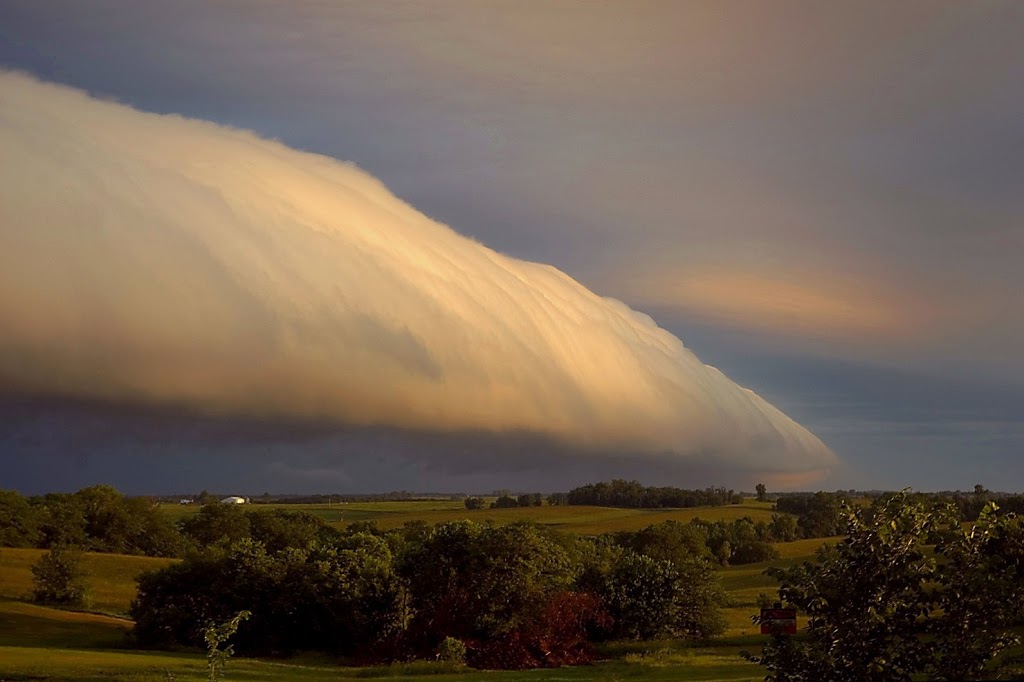
A shelf cloud is a low, horizontal wedge-shaped arcus cloud, associated with a thunderstorm gust front (or occasionally with a cold front, even in the absence of thunderstorms).
Unlike a roll cloud, a shelf cloud is attached to the base of the parent cloud above it (usually a thunderstorm).


Rising cloud motion often can be seen in the leading (outer) part of the shelf cloud, while the underside often appears turbulent, boiling, and wind-torn.
10. Undulatus Asperatus Clouds
Undulatus asperatus is a cloud formation, proposed in 2009 as a separate cloud classification by the founder of the Cloud Appreciation Society. If successful it will be the first cloud formation added since cirrus intortus in 1951 to the International Cloud Atlas of the World Meteorological Organization. The name translates approximately as "roughened or agitated waves".
More Cloud Pictures:
Cloud Book Recommendation
If you are more interested in clouds then I recommend the following cloud book:
If you enjoyed this, please join us and become our fan on Facebook


wow! really cool things! i`ve never think that clouds could be so beautiful!
ReplyDeleteAmazing stuff!
ReplyDeleteWow indeed! These photographs are wonderful. Thanks for sharing them! The explanations for their being are fascinating.
ReplyDeleteJoe
Awesome.. I am no a cloud guy.
ReplyDeleteVery cool clouds ineed!
ReplyDeleteReally, nature at its best.
ReplyDeletenifty
ReplyDeleteBeautiful images. Thanks.
ReplyDeleteI live in on the northern coast of Australia, and we frequently get spectacular examples of roll and shelf clouds during the monsoon season. Not to mention outstanding lightning displays!
Our area is one of the main research zones for tropical storms.
Yay, the pictures plus the explanations were great!! Thanks!!
ReplyDeletecool images.. thanks for posting them :)
ReplyDeleteGreat collection--thanks!
ReplyDeleteI've seen one of the massive shelf clouds before, and that's a sight I won't ever forget.
ReplyDeleteFantastic, I especially liked the Mammatus Clouds. Thanks.
ReplyDeleteReally cool!
ReplyDeleteFantastic collection of cloud photography. FYI, another common name for the Cirrus Kelvin-Helmholtz clouds (at least in the US), is "billows".
ReplyDeleteSay what you will about the mammatus clouds, I always associate those with nasty weather, usually hail. Even just seeing those photos made me feel nervous...
ReplyDeleteGod amazing work 1st hand. AWESOME!
ReplyDeleteGreat pictures and idea to describe it :)
ReplyDeleteUber Cool !!
ReplyDeleteI loved looking at all those clouds - thanks for posting it up - some of them I'd never even seen before like the mammatus clouds - really weird and a very cool post.
ReplyDelete:-)
www.freyasykes.com
Totally AWESOME!!!
ReplyDeleteThanks for the commentary very educational. Never seen anything like those clouds. I will pay more attention now.
Great!!!!!!! Beautiful :) :)
ReplyDeletecool dude!
ReplyDeleteLiterally astounded by these pictures. Glad I saw hem here first. If I witnessed them before or I would probably have freaked!!
ReplyDeleteThis clouds are nifty.
ReplyDeleteCirrus Kelvin-Helmholtz
ReplyDeleteWow,just saw this type of cloud formation above my house on the 1st and wondered what type it was and what was the reason it was shaped like it was.Very good pictures.
This comment has been removed by a blog administrator.
ReplyDeleteAll of these are very beautiful and some spooky looking, I didn't know there were so many kinds of clouds. Thank you for sharing.
ReplyDeleteVery beautiful pics, it's stunning how many different shapes clouds can take
ReplyDeleteVery nice!
ReplyDeleteIsn't nature spectacular!? Thank you so much for sharing these pics and info, so many I had no idea existed. Must be awe-inspiring to see them in person...
ReplyDeletereally cool mate...like the work you have done with this.
ReplyDeleteHello
ReplyDeleteThanks for sharing your great pix. I saw the jellyfish clouds on our trip to Lancaster Pa earlier this week and it was the first time I saw those types of clouds. I was driving so I couldnt get a picture. When I got home I did a search for jellyfish clouds which brought me to your site and those are like the clouds I saw
IT GOD WORK BEAUTIFUL PICTURES THANKS.!!!
ReplyDeletethe true beauty of Nature
ReplyDeleteWow those are fantastic thank you so much!
ReplyDeleteGreat job! Thank you very much for sharing it!
ReplyDeleteGreat photos, well explained - as others have said, wow.
ReplyDeleteI second the book recommendation too - picked it up on a whim the other week and been lost in it on every long journey since.
Thanks!
no words to describe the beauty of nature!!!!!
ReplyDeletesoya the evergreen girl.......
wow. thanks for sharing these pictures. they are very interesting. My meteorology teacher talks about these 10 clouds over and over again.
ReplyDeletewow
ReplyDeletesuch a wonderful phenomenon
i wish i could c Noctilucent Clouds
& Stratocumulus Clouds
KYAA BAAAAAT HAI.AWESOME PHOTOGRAPH.BOHAT ACHI HEIN.ZABARDAST.
ReplyDeleteMesmerising!
ReplyDeleteVery beautiful pictures - thanks for sharing.
ReplyDeleteNice pics ...what do you figure that object above the roll cloud is in the 10th pic from the bottom?
ReplyDeleteCheck out the "atmospheric optics" site for more good info on these clouds.
ReplyDeleteone of your mushroom clouds is actually a LENTICULAR cloud. check the one with the lens shape... right above the mountain.
ReplyDeleteprobably just an accident.
kudos still.
-miranda
i love thees pics they are amaizing!!!!!!!!!!!!!!!!!!!!!!!!
ReplyDeletejust wonderful
ReplyDeleteAmazing!!!!!!!!!!!
ReplyDelete^^ Thanks for the pics. They are awesm! These picturez really helped me on my project. Im going to talk all about it to the class. One day I wish to witness these types of cloudz when I look up into the sky while im on my porch. THANKS AGAIN FOR THE PICTUREz.
ReplyDeleteYes, without a doubt you have incredible pictures here. But, you need to know what is really causing these disruptions to nature. Look at and read the picture descriptions, as well as, the supporting links at this website:
ReplyDeletehttp://imageevent.com/firesat/strangedaysstrangeskies
Unfortunately, you are looking at poisonous Chem Trail fall out agitated by HAARP. The pinkish colors in the clouds are from the presence of Ethyline Dibromide, a cancerous agent added to jet fuel.
These clouds may look spectacular but, they are making each of us very sick....
Good Info. Sometime its happen but no camera to snap. Last year i went to Australia, there is no cloud during almost 2 weeks i've been there. It just blue sky.
ReplyDeleteTotally awesonme--I am a cloud addict and never even knew about these clouds! I guess that you can never rely on the poster that you saw on a horrible teacher's wall...
ReplyDeleteI was speechlessly marveling at the weird-but-amazing photos!
ReplyDeleteThose are the most amazing Clouds i have ever seen !
ReplyDeleteGreat pictures, thanks! A couple of errors though:
ReplyDelete1. The so-called "mushroom" cloud over Mount Fuji may look like a shiitake, but it is nonetheless clearly a lenticular cloud.
2. The first image filed under lenticular clouds is a mammatus.
3. Nacreous clouds are not the same as sun dogs. Both feature reflections of the sun in high-altitude ice crystals - but different types of reflection. Sun dogs appear at the same elevation as the sun (but off to the side) and are thus never visible after sunset.
Fab pics. I've got a cool cloud pic you can add if you like :-)
ReplyDeleteThose are some damn god pictures... i've studied weather for years and those pictures show good base clouds and mesocyclones about to form.
ReplyDeleteSurprised and Speechless.. Awesome work...
ReplyDeletesuperb cool...amazing
ReplyDelete